
Large SUVs, pickup trucks, vans, and commercial vehicles have become common on American roads, but their size can create visibility challenges that smaller passenger cars may not have to the same degree. Tall hoods, wide pillars, large mirrors, and elevated seating positions can leave areas around a vehicle that a driver cannot directly see. These blind zones can become particularly important when pedestrians or cyclists are nearby.
Vehicle blind zones are receiving renewed attention in 2026. A recent U.S. Government Accountability Office report examined the relationship between larger vehicles, driver visibility, and pedestrian and cyclist safety. Understanding where these visibility limitations occur may help drivers become more aware of what can disappear from view around a large vehicle.
Why Vehicle Blind Zones Are Getting More Attention
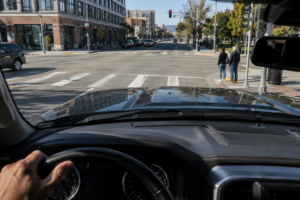 Vehicles sold in the United States have generally become larger over time. SUVs and pickup trucks now represent a major part of the passenger vehicle fleet. Their added height and size can provide occupants with more interior room and cargo capacity, but those dimensions also affect what drivers see from behind the wheel.
According to the GAO, about 9,200 pedestrians and cyclists were killed on U.S. roadways in 2024. That represented an increase of about 65 percent compared with 2010. Many different factors influence pedestrian and cyclist crashes, including speed, roadway design, lighting, distraction, and driver behavior. Vehicle visibility is another factor researchers and transportation officials are examining.
The issue is not limited to the familiar blind spot beside a vehicle. Areas immediately in front of a tall vehicle, alongside it, and behind it can all become difficult to see from the driver’s normal seating position.
What Is a Vehicle Blind Zone?
A blind zone is an area around a vehicle that the driver cannot see directly. Mirrors, cameras, sensors, and other technology can provide additional information, but they do not necessarily eliminate every visibility limitation.
The location and size of these areas vary according to vehicle design. A sedan with a relatively low hood may provide a different forward view than a tall pickup truck. A commercial truck can create still larger areas where nearby road users become difficult to see.
Front Blind Zones
One increasingly discussed problem involves the area immediately in front of larger vehicles. A tall or long hood can prevent a driver from seeing objects or people close to the front bumper.
This can be particularly relevant around children because of their height. A person standing several feet in front of a large vehicle could be less visible than someone farther away. The exact distance varies based on the vehicle, driver position, road grade, and other conditions.
Side Blind Zones
Drivers have long been taught to check side mirrors before changing lanes, but side visibility also matters during turns. Cyclists, scooter riders, and pedestrians can travel alongside a vehicle just as the driver begins turning.
Large mirrors, windshield pillars, vehicle height, and body design can obstruct portions of the driver’s view. This means a road user visible a few moments earlier could become temporarily hidden as the vehicle changes position.
Right Turns Can Create Complex Visibility Problems
Right turns deserve particular attention because several movements can occur simultaneously. A driver may watch approaching vehicles, traffic signals, the crosswalk, and the destination lane while a cyclist travels forward on the vehicle’s right side.
GAO’s 2026 analysis found that larger vehicles presented greater visibility concerns during certain turning situations. Heavy-duty trucks showed especially significant differences compared with passenger cars in the agency’s analysis of fatal pedestrian crashes.
Why Large SUVs and Pickup Trucks Can Be Different
Not every SUV or pickup has the same visibility characteristics. Vehicle dimensions and designs vary considerably. Still, several features commonly associated with larger vehicles can affect sight lines.
A taller hood may obscure a larger portion of the road close to the vehicle. Wider windshield pillars can hide people approaching from an angle. Larger side mirrors may improve rearward visibility while simultaneously blocking a small portion of the forward-side view.
Elevated driver seating also changes perspective. Sitting higher can provide a broad view of traffic farther ahead, yet nearby objects can become more difficult to see immediately around the vehicle.
Technology Helps, but Drivers Still Need to Look
Modern vehicles increasingly include cameras, parking sensors, blind-spot monitoring, pedestrian detection, and automatic emergency braking. These features can provide valuable additional information about the vehicle’s surroundings.
However, driver-assistance technology has limitations. Weather, dirty cameras, unusual road geometry, low light, sensor obstruction, and system design can affect performance. Drivers should understand the features available in their particular vehicle rather than treating automated alerts as a substitute for observation.
This principle is also becoming important with more advanced driving technology. The National Transportation Safety Board continues to study advanced driver-assistance systems and driver engagement. Accident prevention still depends heavily on drivers remaining attentive to surrounding traffic and vulnerable road users.
Situations Where Blind Zones Matter Most
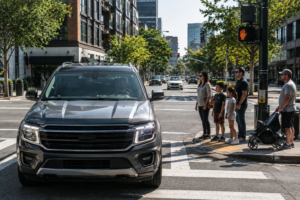 Visibility limitations can appear almost anywhere, but certain environments demand additional attention. Parking lots frequently place pedestrians close to moving vehicles. Residential streets may have children, cyclists, pets, parked vehicles, and driveway traffic. Urban intersections combine pedestrians, bicycles, cars, buses, trucks, signals, and turning movements within a relatively small area.
Driveways also create a common visibility challenge. A driver leaving a driveway may focus on traffic approaching from the roadway while a pedestrian moves along the sidewalk. Backing movements can present similar problems when people pass behind parked vehicles.
More information about recognizing roadway hazards and navigating changing traffic environments can be found through Accident Navigator.
What Drivers Can Do Around Pedestrians and Cyclists
Drivers of larger vehicles can become familiar with their vehicle’s sight lines before entering busy traffic. Sitting in the normal driving position and understanding where the hood, mirrors, and pillars restrict vision can provide useful perspective.
Approaching crosswalks and intersections at manageable speeds also gives drivers more time to observe people who may enter or cross the roadway. Before turning, drivers can scan the crosswalk, mirrors, adjacent bicycle lanes, and the intended travel path.
Extra care may also be useful when starting from a stopped position. Someone walking close to the front of a large SUV or truck could temporarily disappear from direct view.
What Pedestrians and Cyclists Should Understand
Pedestrians and cyclists cannot assume that a driver has seen them simply because they can see the vehicle. Position, vehicle design, lighting, traffic conditions, and driver attention all affect visibility.
Remaining visible around large vehicles may mean avoiding prolonged travel directly beside a truck, watching for turning signals, and approaching intersections with awareness that a driver may be monitoring several directions at once.
The National Highway Traffic Safety Administration’s pedestrian safety resources provide additional information for both drivers and people traveling on foot.
Vehicle Design Is Becoming Part of the Road Safety Discussion
For many years, road safety discussions concentrated primarily on speeding, impaired driving, distraction, seat belts, and roadway engineering. Those issues remain significant. Vehicle design and direct driver visibility are now receiving additional attention as SUVs, pickups, and other large vehicles occupy a growing share of American roads.
The GAO has called for the Department of Transportation to develop better methods for measuring driver visibility around passenger vehicles and commercial trucks. Better data could help researchers compare vehicle designs and understand where visibility-related risks occur.
A More Complete View of Accident Prevention
Large vehicle blind zones do not explain every pedestrian or cyclist accident. Crashes often involve a combination of road design, speed, lighting, behavior, traffic conditions, visibility, and vehicle characteristics. Treating vehicle visibility as one part of a broader safety picture provides a more useful way to understand the issue.
For drivers, knowing where a vehicle’s blind zones are can encourage better observation before turning, backing, or entering an intersection. For pedestrians and cyclists, understanding that large vehicles may have significant areas outside the driver’s direct view can help explain why extra awareness around trucks and SUVs matters.
As vehicles continue changing in size and technology, research into driver visibility may become an increasingly important part of U.S. roadway safety. Accident Navigator can continue following these developments as new federal research, vehicle technologies, and traffic safety data become available.